Senior Researcher at the Research Center for Electronic and Optical Materials, National Institute for Materials Science (NIMS). Ph.D. in Science, Kyoto University.
At the NIMS Namiki site in Tsukuba, Ibaraki, Japan, I study preparation methods and applications of monolithic porous materials using organic–inorganic hybrid gels and nanofibers.
My research covers porous materials, including aerogels and marshmallow gels, from material design and preparation to characterization and application development.
Research keywords and themes
Inorganic chemistry / organic–inorganic hybrids / liquid-phase synthesis / sol–gel processing / ceramics / interfaces and colloids / porous materials / aerogels / marshmallow gels / silicones / silsesquioxanes / nanofibers / liquid repellency / separation media / thermal insulation / optical materials / sensors
Representative research themes are introduced on this website.
Research participation and collaboration
For researchers and students at universities and public research institutions
Collaborative research
I collaborate with researchers at Tokyo University of Agriculture and Technology, Tohoku University, the University of Tsukuba, AIST, Osaka University, and other institutions by providing materials, preparation methods, and characterization techniques for porous materials. Researchers interested in these materials are welcome to contact me. I will respond to requests where feasible.
Hosting students and postdoctoral researchers
Inquiries about participating in research are welcome.
I host students each year for periods of 1–3 months through the NIMS Internship Program, which provides a daily allowance and can accommodate inquiries outside the application period, and the NIMS International Cooperative Graduate Program. Students from any university are welcome to inquire by email.
Postdoctoral researchers can join through programs such as the JSPS Research Fellowship for Young Scientists (PD).
Laboratory facilities
The laboratory supports material design and liquid-phase synthesis through drying, processing, physical characterization, and observation. Alongside commercial instruments, I build experimental fixtures and circuit boards in-house. Please contact me about equipment use or joint characterization.
Liquid-phase synthesis and specimen preparation
Equipment is available for liquid-phase synthesis, primarily sol–gel processing, including weighing, mixing, dispersion, extraction, concentration, and molding.
- Water purification system (ion-exchanged water): Yamato Pure Line WL220
- Analytical balance: A&D GX124AE
Planetary centrifugal mixer: THINKY AR-100
A compact THINKY planetary centrifugal mixer for liquid-phase synthesis. Nanofiber and nanoparticle dispersions that readily trap bubbles can be mixed and degassed within tens of seconds. Dry powders can also be mixed if they do not scatter readily. Capacity is limited to approximately 30 mL, but the instrument is useful. Vial and syringe adapters are also available.
- Fluid mixer: KAWATA Super Mixer Piccolo SMP-2
Ultrasonic homogenizer: Yamato LUH150
An ultrasonic homogenizer for small dispersions. Its compact size makes it relatively quiet, and its performance is sufficient for volumes around 20 mL.
- Benchtop centrifuge: KUBOTA S500T
- Immersion extraction apparatus: custom unit based on Kiriyama EX92B-1-3
- Rotary evaporator: EYELA N-1300E + NVC-3000
Pen-type syringe pump: Takasago SBP-100G-LLC + MYCOM ICD200-1120A-03-1
A stepper-motor syringe pump used to dispense droplets on the microliter scale. It is controlled by a PC over USB. Because the software controls motor motion rather than liquid volume directly, volume settings require conversion by multiplication or division. The pump is compact and precise.
Mounting the pump on the pen attachment of a Dobot Magician allows dispensing while positioning the syringe.
- Planetary pot mill: Ito LP-1
- Ball-mill stand: Ito PSL-1M with cover
- Handheld UV irradiation unit: Mario Network Handy UV 1200mW
- Vacuum degassing mixer
- Vial evaporator
- Rotating mixer
- Shaker
- Syringe pump
- Peristaltic pump
- Piezoelectric micropump
- Cutter mill
- Various stirrers
Drying, heat treatment, and storage
The laboratory supports drying-condition studies for aerogels and other porous materials, calcination, and atmosphere control.
Supercritical CO₂ dryer: Sanyu SYGLCP-81
A relatively inexpensive supercritical dryer that accommodates approximately two aerogel specimens, each about 4 cm in diameter.
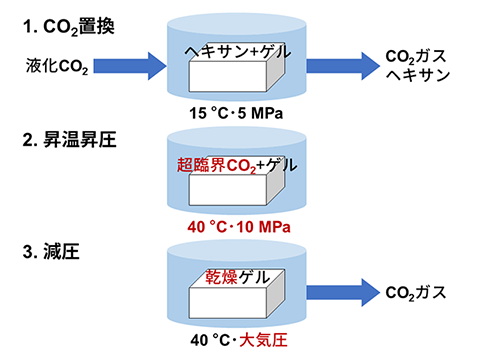
Supercritical-drying sequence Liquid CO₂ is flowed at 15 °C for half a day to replace hexane within the wet gel. Closing the valve and heating to 40 °C produces supercritical conditions at approximately 10 MPa. Depressurization then yields the dry specimen. The wet gel must first be exchanged into a nonpolar solvent such as hexane; insufficiently dehydrated specimens cannot be processed by this route.
The O-ring swells after use and must be replaced or allowed to recover. The simple mechanism makes the instrument straightforward to operate with experience.
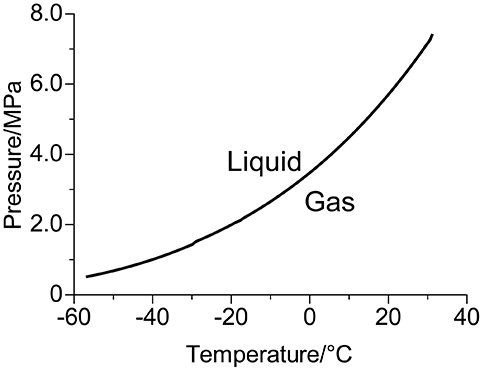
Vapor-pressure curve of liquid carbon dioxide The Wikipedia data page provides reference information on the vapor pressure of liquid CO₂.
Freeze dryer: EYELA FDU-1200
A conventional vacuum freeze dryer comprising a vacuum chamber with a cold trap. It does not cool the sample stage, but loading frozen specimens and switching it on starts drying together with the vacuum pump. It is also useful for removing water from specimens. Replacing the stage with a hose connector allows it to serve as a cold trap for other equipment.
- Variable-airflow drying oven with explosion vent: custom Yamato DNF401
Electric furnace: Yamato FO101, customized for N₂ introduction
A conventional small furnace customized with N₂ introduction and an exhaust opening. It is installed in a fume hood to remove generated gases. Nitrogen and air can be connected.
High-temperature furnace: AS ONE ROP-001H
At the time of purchase, this was the least expensive small electric furnace capable of reaching 1300 °C for α-alumina preparation. Because this exceeds its usual operating temperature, I reserve such operation for selected occasions.
Vacuum atmosphere furnace: Denken-Highdental KDF-75Plus (N₂ and air)
A vacuum atmosphere furnace covering room temperature to 1000 °C. A nitrogen line permits firing under an inert atmosphere; dry air from an air compressor can also be introduced.
Programming on the LCD is straightforward, so I also use it as an ordinary furnace for specimens unlikely to contaminate it. The supplied ULVAC pump requires frequent oil changes and is mounted on an EYELA OPM-1000 stand.
- Small electric furnace: Nitto Kagaku Yellow miniBSⅠ
- Refrigerator with explosion-proof interior: Nihon Freezer / Liebherr LKEXV-1800
Deep freezer: Nihon Freezer My Bio VT-78HC
A compact deep freezer used to prefreeze specimens for vacuum freeze-drying when liquid nitrogen is unnecessary.
- Cooled incubator: AS ONE / Fukushima Galilei KMH-050
- Cold trap: Yamato CA100
- Vacuum drying oven
Processing and cleaning
Facilities support specimen cutting, molding, and surface modification, as well as prototyping fixtures and parts for characterization.
CO₂ laser cutter: smartDIYs FABOOL Laser CO2
A DIY CO₂ laser system from a Japanese manufacturer. Assembly took 25 hours.
It is useful for cutting acrylic sheets. Laser irradiation chars materials such as silicone and paper, enabling specimen marking. Rough cutting is possible for specimens 2–3 mm thick. The software is simple, but power and speed must be optimized by the user. Although used infrequently, the instrument is helpful when needed.
The instrument appears in the Supporting Information of Hayase and Nomura, ACS Applied Polymer Materials (2019).
Benchtop CNC mill: ORIGINALMIND KitMill CL200 with PCB-machining attachment
A benchtop CNC milling machine that requires self-assembly but provides reasonable accuracy.
I use it to mill gel molds and fixtures of arbitrary shape from PTFE blocks and remove specimen surface skins to create flat surfaces. The CAM software is Cut2D Desktop and Cut3D Desktop.
It also supports machining of blank circuit boards. I build sensor mounts for Arduino and M5Stack and UV- or IR-LED light sources.
Benchtop vacuum former: Rayama Pack V.former
A benchtop vacuum former used to make custom gel molds and protective blister packs for specimen transport. The vacuum pump is very loud when switched on.
Fused-filament 3D printer: Bambu Lab P1S
A fused-filament 3D printer with an enclosure for maintaining temperature and an AMS automatic material supply system.
I use both official and general-purpose PLA, PETG, TPU, HIPS, and PA filaments. Prototypes made with the official wood PLA filament can also be kept as display pieces.
In my experience, printing accuracy and success rate are substantially better than with the previously used Flashforge Adventure 4, to the point that resin printing is rarely needed. I use Shiwa-nashi PIT G adhesive to secure prints to the build plate.
- Resin 3D printer: Phrozen Sonic Mini 8K S
Small vacuum plasma system: Sakigake Semiconductor NMR-Gts
A compact, inexpensive vacuum plasma system. It permits simple trials of hydrophilization of sheets up to 5 mm thick or powders, and bonding between glass and PDMS surfaces.
- Cutting machine: Brother SDX1000
- Ultrasonic stapler: Suzuki Marine Haruru AUH30
- Small ultrasonic welder: Suzuki Marine AUH30CW
- Ultrasonic cleaner: Yamato / Branson Bransonic CPX5800-J
Physical characterization
Mechanical properties, thermal conductivity, and gas adsorption of porous materials are measured.
Mechanical testing instrument: Shimadzu EZ-SX
A Shimadzu mechanical testing instrument currently fitted with a 100 N gauge for uniaxial compression, three-point bending of plastics, and tension. The optional jog dial is important for fine specimen positioning. Dedicated cyclic-testing software is installed.
The hardware is compact, capable, and supported by a wide range of fixtures. In my experience, the separately purchased TRAPEZIUM X software has shortcomings, including a requirement for .NET Framework 1.1 and occasional rejection of particular numerical inputs. Better software would make fuller use of the hardware. The interface may be difficult for users accustomed to smartphones.
Exported CSV data can contain many rows and become slow to process in Excel. A conversion program is useful. I use Python for preprocessing before plotting.
Thermal-conductivity instrument (HFM): NETZSCH HFM 446 Lambda Small
An instrument for measuring thermal conductivity of aerogels and other porous materials. The heat-flow-meter method measures low-conductivity specimens of sufficient thickness, following standards such as JIS A 1412-2:2016. Few instruments are suitable for aerogel measurements; this model operates satisfactorily for my specimens.
Gas adsorption instrument: Microtrac BEL BELSORP MAX
This instrument is on loan from Kyoto University. It is used to measure adsorption isotherms and BET specific surface area.
Because micropore characterization is not performed, BET specific surface area is evaluated at seven relative pressures: 0.050, 0.075, 0.100, 0.150, 0.200, 0.250, and 0.300.
- Constant-mass tapped bulk-density instrument: Tsutsui TPM-1A
Optical characterization, observation, and imaging
Facilities support transmittance and reflectance measurements, microscopy, and imaging from the visible to the near-infrared region.
FTIR with diamond ATR: Shimadzu IRSpirit-T + QATR-S
A compact Shimadzu FTIR instrument used primarily with diamond ATR. It was installed for specimens and reactions unsuitable for shared facilities, such as powder-shedding aerogels or reactions involving toxic substances. An automatic dehumidifier is fitted. The instrument is used in a simple clean booth but is small enough to move into a fume hood.
Monitoring humidity and CO₂ during measurements helps obtain clean spectra. Software inconveniences remain, including changing from transmittance to absorbance after ATR correction. I would welcome further software development.
Total transmittance and reflectance measurement system
I purchased an ASAHI Spectra total-transmittance system, now discontinued. Because its integrating sphere and its light source and spectrometer were financed from different grants, only the sphere could be transferred. I now use a Tokina KTX-100E halogen source and Hamamatsu TF C13555MA spectrometer with a slightly modified optical fiber.
Reconnecting the HSU-O-DTR ports also permits total-reflectance measurement. Simple measurements use a separately purchased diffuse-reflectance standard as the reference.
The system is useful because readily accessible total-transmittance instruments are uncommon. It does not measure diffuse transmittance or haze.
- Xenon light source: ASAHI Spectra LAX-C100
- Halogen light source: ASAHI Spectra FHL-102
- Integrating-sphere unit: ASAHI Spectra HSU-O-DTR
- Spectrometer: ASAHI Spectra HSU-100H
- Tungsten–halogen light source: Thorlabs SLS201L/M
- Collimator unit: Thorlabs SLS201C
- Cuvette holder: Thorlabs CVH100/M
- Integrating sphere: Thorlabs 2P4/M
- Miniature spectrometer: Hamamatsu TF C13555MA
- Halogen light source: Kenko Tokina KTX-100E
- Fiber-coupled LED light source: Edmund Optics, 530 nm, 5 mW, 1000 mA
- Small line laser: Kiko Giken MLXK-D13-650-5
Metallurgical microscope: RAYMER RM-5400T
A metallurgical microscope with magnification up to 500× that accommodates thick specimens. It supports bright-field and simple polarization observation. At the time of purchase, a complete setup with an interchangeable-lens-camera attachment cost less than JPY 500,000. I use it to check micrometer-scale structures. Strong scattering in porous specimens requires care with specimen preparation and illumination.
Stereo microscope: RAYMER LW-820
A stereo microscope configured for reflected and transmitted bright-field illumination, simple dark-field illumination, and a low-angle LED ring light. Its trinocular configuration accommodates cameras.
- Custom-built microscope
- Microscope body: Sigma Koki two-port coaxial-illumination observation unit OUCI-3-M1M
- Spot illumination: CCS HLV3
- Liquid lens: Optotune EL-12-30-TC-VIS-16D-C
- Objectives: Shibuya Optical HLB M Plan Apo series
Industrial C-mount camera, USB3.0 high-speed monochrome: Baumer VCXU-02M
A compact monochrome VGA industrial USB3.0 Vision camera.
I initially planned to develop acquisition software using OpenCV, but the official evaluation software readily adjusts image size and frame rate. Its large buffer allows a standard laptop to record several seconds at 720 × 360 pixels, one quarter of HD resolution, and 1000 fps.
- Industrial C-mount camera, USB3.0 color: Baumer VCXU-15C
- Industrial C-mount camera, USB3.0/UVC color and near-infrared: The Imaging Source DFK33UX462
- Industrial C-mount camera, GigE: LUCID Vision Labs PHX051S-CC-IX
InGaAs camera, USB2.0: ARTRAY ARTCAM-991SWIR-WOM + CBC M0814-VSW
A SWIR camera purchased to detect water and solvents and observe processes such as gel drying. USB2.0 limits transfer speed, but VGA resolution is sufficient for ordinary imaging. Bandpass filters from Edmund Optics are selected for solvent absorption wavelengths to visualize their distributions.
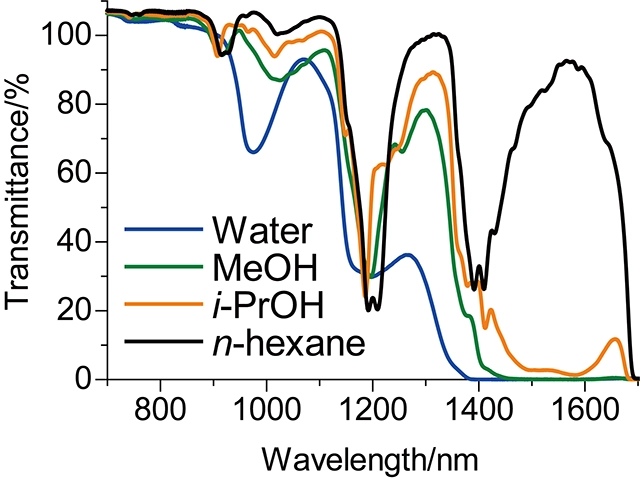
Transmittance through 10 mm of each solvent. The blank was an empty glass cell, so the data include surface-reflection effects. Dedicated 1450 nm LED illumination, corresponding to a water-absorption peak, is expensive. I therefore built a simple light source with Hamamatsu LEDs arranged on a custom annular circuit board. Marshmallow-gel surfaces reflect near-infrared light well, allowing residual surface moisture to be observed with high contrast.
- Polarization camera, GigE: LUCID Vision Labs PHX050S1-QC
- Event-based vision camera, 2.5GigE: LUCID Vision Labs TRT003S-EC
Time-lapse imaging: Raspberry Pi 4 + UVC camera
A Raspberry Pi connected to a camera module or UVC camera provides an inexpensive imaging system. For stability, a miniature portable SSD is used as the boot drive instead of a microSD card. GPIO-connected switches make triggering straightforward.
Pi HQ Camera
Connecting the camera to a C-mount lens or microscope and running a custom shell script enables interval imaging followed by automatic time-lapse video export with FFmpeg.
Camera Module V2
Camera Module V2 officially supports VGA recording up to 200 fps, permitting simple high-speed imaging. Its macro capability also supports approximate droplet-contact-angle measurements from water-droplet images processed in ImageJ.
UVC cameras
The Imaging Source cameras provide interchangeable lenses while retaining UVC compatibility, permitting high-quality imaging.
- Various LED lights
Automation and peripherals
Robot arm: Dobot Magician
A robot arm from a Shenzhen startup. A sliding rail can extend its working range, although space constraints currently require standalone use.
Direct teaching is available, and programming is intuitive. Numerous input/output terminals provide substantial expandability, with good value for the hardware.
A mounted microsyringe pump is used to place droplets for static contact-angle measurements. A UV light attached to the tip is also used for reactions.
The robot appears in the Supporting Information of Hayase and Nomura, ACS Applied Polymer Materials (2019), and Hayase, Bulletin of the Chemical Society of Japan (2021).
Electric cylinder: IAI EleCylinder
Installed to move specimens to fixed positions. An M5Stack Basic and a two-channel SPST relay unit provide button-operated extension and retraction.
- Benchtop robot
- Motion unit: Musashi Engineering SHOTmini100SX
- Temperature-control unit: Musashi Engineering THERMOMASTER
- Digital dispenser: Musashi Engineering ML-6000X
Shared facilities
I use shared facilities at NIMS and through the Inter-University Network for Common Utilization of Research Equipments.
Contact
Students, educators, and researchers at educational, public, or nonprofit institutions
For inquiries about research or hosting, please email the address below and include your name and the reason for contacting me. A brief, informative subject line helps prevent your message from being overlooked among spam. Replies are sent from a different address.
For security, please do not attach files to your initial email.

Companies considering technical consultation, specimen loans, or collaborative research
I collaborate with several companies. Interested companies should contact NIMS through the link below.
General inquiry for companies — National Institute for Materials Science
If we have met at a conference or another event, you may also contact me by email. Please mention the occasion.
Before an NDA is in place, I cannot respond to inquiries or consultations beyond publicly available information. Security considerations and other restrictions may also prevent a response.
Speaking invitations for privately organized seminars
Please state clearly whether the event is expected to proceed. Accepting an invitation involves administrative procedures for outside work, so I ask that confirmed events not be canceled.
Anonymous messages, research-unrelated sales approaches concerning finance, real estate, or books, and unsolicited commercial email are not accepted.